

TL;DR - Summary
AI is getting a physical form. Discover how humanoid robots from companies like Figure, Agility Robotics, Apptronik and Tesla are entering real-world environments and what their progress means for the future of AI and robotics.
On this page
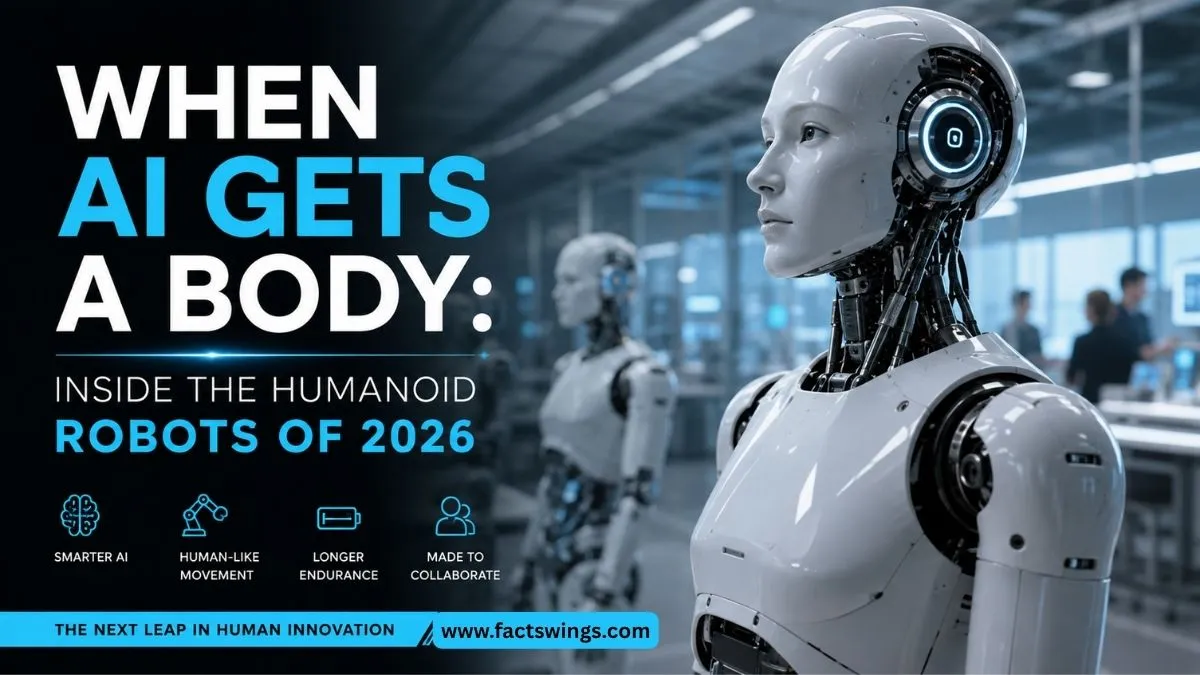
When AI Gets a Body: Inside the Humanoid Robots of 2026
Artificial intelligence has spent years living behind screens. In 2026, that is beginning to change. AI systems are increasingly being connected to cameras, sensors, motors, hands and legs — giving software a physical presence in the real world.
For most people, artificial intelligence still means something that exists on a screen. You type a question into a chatbot, upload a photograph, ask for a summary or tell an AI assistant to write something. The output is digital.
A humanoid robot changes that relationship. Instead of simply telling you what to do, an AI system connected to a robot can potentially look at the world, understand what is happening and perform a physical action.
That sounds futuristic, but parts of this idea are already being tested in factories and warehouses. The important question in 2026 is no longer whether AI can control a physical machine. The question is how reliably, safely and economically it can do useful work.
What Does It Mean When AI Gets a Body?
Giving AI a body means connecting intelligence with physical hardware. Cameras become the robot’s eyes. Microphones can provide another way to understand the environment. Sensors help measure position, force and movement. Motors create physical motion, while software decides what the machine should do next.
This is often described as physical AI or embodied AI. The idea is simple: intelligence should not exist only as information. It should be able to perceive and interact with the physical world.
The distinction matters because physical environments are far less predictable than a computer screen. A document does not suddenly fall off a table. A warehouse worker might move an object. A box can be damaged. Lighting can change. Someone can walk directly in front of a robot.
A useful physical AI system therefore needs more than a powerful language model. It needs perception, planning, movement, balance, manipulation and safety mechanisms working together.
Why Are Humanoid Robots Suddenly Everywhere?
The humanoid shape is not automatically the best shape for every robotic task. A factory arm is usually better at a repetitive assembly operation, and a warehouse vehicle can be more efficient when it does not need legs.
But humans built much of the world around human bodies. Door handles, shelves, stairs, workstations, tools and production areas are generally designed for people.
That gives humanoid robots an interesting advantage: instead of rebuilding an entire environment for a machine, engineers can try to make the machine fit into an environment that already exists.
That is one reason manufacturers and logistics companies are paying close attention to humanoid robotics.
If you want a broader look at how AI is moving beyond traditional software interfaces, see our related article: The Next AI Interface May Have Arms, Legs and Eyes.
Figure: From Factory Experiment to Another Generation
Figure AI is one of the companies pushing the idea of a general-purpose humanoid robot. Its work has attracted attention because the company has moved beyond demonstrations and into industrial testing.
In 2025, Figure reported that its Figure 02 robots had been deployed at BMW’s Spartanburg plant. According to Figure, the robots accumulated more than 1,250 hours of runtime and contributed to production involving more than 30,000 BMW X3 vehicles.
That does not mean a humanoid robot built an entire vehicle. It is a much narrower example of a robot performing specific work within a larger manufacturing process. That distinction is important.
In June 2026, Figure said its newer Figure 03 had arrived at BMW’s Spartanburg facility following the earlier Figure 02 deployment. The company described this as the next stage of its relationship with BMW.
Agility Robotics and Digit: A Different Kind of Progress
Agility Robotics has taken a different route with Digit, focusing heavily on logistics and industrial environments.
The company describes Digit as a commercially deployed humanoid robot. Its design is intended for environments where people already work, making the robot particularly relevant to warehouses and manufacturing facilities.
Agility has also expanded commercial activity in 2026. In February, the company announced a Robots-as-a-Service agreement with Toyota Motor Manufacturing Canada following a successful Digit pilot.
The important lesson here is that humanoid robotics is not developing only through flashy demonstrations. Companies are also experimenting with business models, deployment contracts, fleet management and the practical question of whether robots can deliver measurable value.
Apptronik Apollo: Building a Robot for Human Spaces
Apptronik’s Apollo is another major humanoid project. The company positions Apollo as a general-purpose system designed for manufacturing, warehouses and other environments where people already work.
Apptronik announced a commercial agreement with Mercedes-Benz in 2024 to pilot Apollo in manufacturing facilities. The project became an important example of a major automaker exploring humanoid robotics as part of its industrial strategy.
The broader idea is straightforward. If a robot can safely move through human workspaces and perform physically demanding or repetitive tasks, companies may eventually be able to use it without redesigning every part of their facilities.
But there is a large gap between a pilot and mass deployment. Robots still need to become faster, more reliable, easier to maintain and economically competitive with other forms of automation.
Google DeepMind Is Working on the Intelligence Layer
Hardware is only half of the humanoid robotics story. A robot needs an intelligence system capable of turning perception and instructions into physical actions.
This is where Google’s robotics research becomes particularly interesting. In July 2026, Google DeepMind introduced Gemini Robotics 2, describing it as a vision-language-action model capable of controlling robots ranging from smaller robotic systems to full humanoids.
According to Google DeepMind, the model can control whole-body movements, including walking, crouching, stretching and manipulating objects. The company demonstrated the system with Apptronik’s Apollo 2.
The change is significant because earlier robotics systems often relied heavily on predefined movements or narrow task-specific programming. A more flexible AI model can potentially interpret instructions and adapt its actions to changing circumstances.
DeepMind also introduced robotics models designed for embodied reasoning and on-device operation. The broader goal is to make robots better at understanding physical environments, planning multiple steps and acting with less dependence on remote computing.
What About Tesla Optimus?
Tesla is also developing a general-purpose humanoid called Optimus. Tesla describes its objective as creating a bi-pedal autonomous humanoid capable of performing unsafe, repetitive or boring tasks.
Optimus has received enormous public attention because Tesla is attempting to combine its experience in AI, manufacturing, batteries, motors and autonomous systems into a humanoid platform.
However, it is important to separate public demonstrations and company ambitions from proven large-scale commercial deployment.
As of 2026, Optimus remains a development project rather than a widely available consumer product. The larger industry is still trying to answer fundamental questions about cost, reliability, autonomy and safety.
What Humanoid Robots Can Actually Do in 2026
The honest answer is more modest than many viral videos suggest. Humanoid robots can perform increasingly impressive tasks, but they are not yet universal workers.
Factory Tasks
Robots can be tested for material handling, component movement, inspection and other structured manufacturing activities.
Warehouse Work
Moving containers, handling objects and supporting logistics are among the most practical early applications for humanoid systems.
Object Manipulation
New AI models are improving the ability of robots to identify objects, grasp them and perform multi-step physical actions.
Research & Training
Robots are also being used as platforms for collecting physical data and testing embodied intelligence systems.
The Reality Check: Humanoid Robots Are Still Difficult
It is easy to watch a robot walk, dance or pick up an object and assume the technology is almost finished.
It is not.
A controlled demonstration can be very different from working eight hours in a busy factory. Real environments contain unexpected objects, changing lighting, human workers, slippery surfaces, mechanical wear and countless small variations.
Recent reporting from Reuters in August 2026 highlighted this gap in China’s rapidly expanding humanoid industry. Reuters observed robots performing simple tasks in a training environment but also reported that many systems remained slow and error-prone for demanding factory work.
That is an important reality check. The robotics race is moving quickly, but impressive hardware does not automatically equal useful autonomy.
China’s Humanoid Robot Race
China has become one of the most aggressive markets for humanoid robotics. Numerous companies are developing machines, while government support and manufacturing infrastructure are helping accelerate the industry.
Chinese companies have also demonstrated robots performing visually impressive activities, including sports and choreographed movements.
But the same industry faces a difficult question: can demonstrations become dependable commercial work?
Reuters reported in August 2026 that Chinese humanoid manufacturers were facing challenges involving cost, intelligence, reliability and real-world demand. Some robots remain much slower than human workers when performing practical tasks.
This may ultimately be good for the industry. Competition can push hardware prices down, encourage better AI models and create more data for training. But it can also expose companies that have impressive prototypes without a sustainable commercial use case.
Why Hands May Matter More Than Legs
Walking robots look impressive, but hands may be the real bottleneck.
Humans can pick up thousands of objects without thinking about the exact movement required. We can open a drawer, hold a fragile cup, turn a small screw or move an irregular object.
Robots have historically struggled with these small variations.
This is why recent progress in dexterous robotic hands is important. Google DeepMind’s 2026 robotics work demonstrated AI-controlled manipulation involving complex hand movements, including tasks requiring multiple fingers and coordinated motion.
The goal is not to make a robot look human. The goal is to make it capable of handling the messy physical details that humans normally perform without conscious effort.
Will Humanoid Robots Replace Human Workers?
This is probably the most important question surrounding the technology.
The short answer is that some tasks are likely to become more automated, but the overall impact will be more complicated than simply replacing people with machines.
Early deployments are likely to focus on repetitive, physically demanding, hazardous or highly structured tasks. Human workers may continue handling supervision, maintenance, quality control, exception handling and jobs requiring social judgment.
Over time, however, increasingly capable robots could change the economics of certain industries. A machine that can work for long periods, move between different tasks and learn new workflows could become a powerful productivity tool.
That means the more useful question may not be “Will robots replace humans?” but “Which human tasks will become easier, automated or redesigned because robots can perform them?”
The Safety Problem Gets Bigger When AI Can Act
A chatbot can provide a bad answer. A physical robot can make a bad decision and physically affect its surroundings.
That makes safety a fundamental part of embodied AI.
Robots working around people need reliable perception, controlled force, emergency mechanisms and clear operational boundaries. AI models also need ways to handle uncertainty instead of confidently taking the wrong action.
This is one reason robotics cannot be treated as simply another software category. A software update can change how a robot behaves in the physical world, so testing and validation become extremely important.
For a deeper look at the broader AI security landscape, explore our Cybersecurity Best Practices Guide 2026.
AI Is Moving Beyond the Screen
The next generation of AI may not just answer questions. It may see, move, manipulate objects and work alongside people. Explore more evidence-based AI and technology stories on FactsWings.
Explore More AI & TechnologyWhat Happens Next?
The next few years will probably be less dramatic than science-fiction movies suggest — but potentially more important.
We are unlikely to wake up one morning and discover millions of humanoid robots doing every household task. Instead, progress will probably happen quietly through specific deployments.
A robot moves boxes in a warehouse.
Another helps with a repetitive factory process.
Another learns to handle objects more reliably.
AI models become better at understanding physical spaces.
Engineers collect more real-world data.
Each improvement feeds the next one.
That is how the transition from experimental robotics to useful physical AI is likely to happen.
The Bigger Idea: AI as a Physical Interface
For decades, computers gave humans access to digital information. Smartphones made that access portable. Generative AI made interaction with software dramatically more natural.
Humanoid robotics could represent another step: giving intelligent software a physical interface.
Instead of asking an AI system only to write, search or explain, we could eventually ask it to interact with the world.
“Clean the table.”
“Move these boxes.”
“Bring that tool.”
“Help prepare this workstation.”
Those instructions sound simple because humans already understand the physical world around them. For an AI robot, each sentence can represent a chain of perception, reasoning, movement and safety decisions.
That is why 2026 may eventually be remembered not as the year humanoid robots became fully mature, but as a year when the connection between advanced AI and physical machines became much more concrete.
Final Takeaway
AI getting a body is not one single invention. It is the convergence of several technologies: computer vision, language models, robotics, sensors, batteries, motors, manipulation, simulation and increasingly sophisticated AI control systems.
Figure’s work with BMW, Agility Robotics’ commercial Digit deployments, Apptronik’s Apollo partnerships and Google DeepMind’s robotics models all show different pieces of the same larger movement.
But the technology is still early. Humanoid robots remain expensive, imperfect and highly dependent on the environment and task.
The real breakthrough will not be a robot that can dance for two minutes. It will be a robot that can reliably perform useful work every day, safely, economically and with far less human intervention.
When that happens, AI will no longer be something we only talk to. It will be something that can physically act in the world around us.
Frequently Asked Questions
What does “AI getting a body” mean?
Are humanoid robots actually being used in 2026?
Which companies are developing humanoid robots?
What is Google DeepMind doing in robotics?
Can humanoid robots replace humans?
Are humanoid robots ready for homes?
What is the biggest challenge for humanoid robots?
Why are humanoid robots useful if traditional robots already exist?
Sources & Reporting Notes
- Google DeepMind: Gemini Robotics 2 documentation and July 2026 announcement covering whole-body humanoid control, dexterity and embodied AI.
- Figure AI: Company reporting on Figure 02’s BMW Spartanburg deployment and the subsequent arrival of Figure 03 at BMW in 2026.
- Agility Robotics: Company information on Digit’s commercial deployment and its 2026 Robots-as-a-Service agreement with Toyota Motor Manufacturing Canada.
- Apptronik: Company announcement regarding the Apollo humanoid robot’s commercial relationship with Mercedes-Benz.
- Reuters: Independent August 2026 reporting on China’s humanoid robotics industry, including the gap between impressive demonstrations and practical factory performance.
Editorial note: Company-reported performance figures are identified as company claims where appropriate. FactsWings distinguishes between announced plans, demonstrations, pilot programs and established commercial deployment. Robotics capabilities can change quickly, so this article should be updated as new verified information becomes available.

Mehedi Hasan - Tech & AI Researcher
Md. Mehedi Hasan is the founder and editor of FactsWings. Passionate about AI, technology, science, cybersecurity, and fact-based journalism. Dedicated to publishing accurate and trustworthy content for a global audience.
View all posts →Frequently Asked Questions
Are these facts verified?
Yes, every fact is fact-checked from primary sources like NASA, BBC, Nature, and peer-reviewed papers.
Do you use AI to write?
No. All articles are human-written and human fact-checked. We disclose affiliate links per FTC guidelines.