

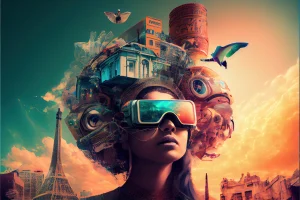
Source: 3D Visual by Facts Wings
AI Breakthrough in 3D Visual Technology: Revolutionizing the Digital World
Artificial Intelligence (AI) has been reshaping industries at an unprecedented pace, and one of the most exciting frontiers of this transformation is in 3D visual technology. From gaming and entertainment to architecture, healthcare, and autonomous systems, AI-driven advancements in 3D visualization are unlocking new possibilities that were once confined to the realm of science fiction. This article explores the latest breakthroughs in AI-powered 3D visual technology, their applications, and their potential to redefine how we interact with digital and physical worlds. For more insights into cutting-edge innovations, visit FactsWings.
The Evolution of 3D Visual Technology
3D visual technology has come a long way since its inception. Early 3D modeling relied heavily on manual processes, requiring artists and engineers to painstakingly craft every detail of a model. The introduction of computer-aided design (CAD) and 3D rendering software like Blender and Autodesk Maya revolutionized the field, but these tools still demanded significant time and expertise. The integration of AI, however, has taken 3D visualization to new heights, enabling faster, more accurate, and highly realistic outputs.
AI’s role in 3D visualization began with automating repetitive tasks, such as texturing and rigging. Today, generative AI models, neural networks, and advanced algorithms are pushing the boundaries further, allowing for the creation of complex 3D models from simple inputs like text prompts or 2D images. These advancements are not only saving time but also democratizing access to 3D content creation, making it accessible to non-experts. To learn more about the history of 3D modeling, check out.
Key AI Breakthroughs in 3D Visual Technology
Recent developments in AI-driven 3D visual technology have been nothing short of revolutionary. Below are some of the most significant breakthroughs that are shaping the future of this field:
1. Neural Radiance Fields (NeRF) and 3D Scene Reconstruction
Neural Radiance Fields (NeRF) have emerged as a game-changer in 3D scene reconstruction. NeRF uses neural networks to generate highly detailed 3D models from a series of 2D images or videos captured from different angles. Unlike traditional methods that struggle with complex textures and lighting, NeRF produces photorealistic results with remarkable consistency. NVIDIA’s Neuralangelo, for instance, can create intricate 3D objects from short videos, enabling applications in virtual reality, gaming, and digital twins. This technology is particularly promising for industries like architecture and urban planning, where realistic visualizations are critical. highlights how Neuralangelo could transform digital world creation.
2. Generative AI for 3D Model Creation
Generative AI models, similar to those used for text-to-image generation (e.g., DALL·E 2), are now being adapted for 3D content creation. Tools like NVIDIA’s Magic3D and Alpha3D allow users to generate high-quality 3D models from text prompts or single 2D images. These models use diffusion techniques to produce detailed meshes, complete with textures and lighting, in a fraction of the time required by traditional methods. For example, a user can input “a futuristic cityscape” and receive a fully rendered 3D model, ready for use in games or simulations. This breakthrough is revolutionizing industries like gaming and e-commerce, where rapid prototyping of 3D assets is essential. Learn more about NVIDIA’s advancements at.
3. 3D Gaussian Splatting
Another significant advancement is 3D Gaussian Splatting (3DGS), a technique that enhances the efficiency and realism of 3D rendering. 3DGS represents scenes as collections of 3D Gaussian distributions, allowing for faster rendering times and higher visual fidelity compared to traditional methods. This technology is particularly useful in real-time applications, such as augmented reality (AR) and virtual reality (VR), where smooth and realistic visuals are crucial. According to a 2024 arXiv paper, 3DGS has accelerated the development of neural-rendered models, making them more accessible for real-world applications. provides a detailed technical overview of this progress.
4. Multimodal AI for Cross-Modal Understanding
Multimodal AI models, such as NVIDIA’s OMCAT (Omni Context Aware Transformer), are pushing the boundaries of 3D visual technology by integrating visual, audio, and textual data. These models excel in temporal reasoning, aligning events across different modalities (e.g., matching a sound event to a specific moment in a 3D video). This capability is critical for applications like autonomous vehicles, where understanding the spatial and temporal context of a scene is essential. OMCAT’s ability to process 3D spatial data alongside other inputs sets a new benchmark for multimodal AI, as reported by
5. AI-Powered Procedural Animation
In the realm of 3D animation, AI is enabling procedural animation, where characters react dynamically to environmental changes in real time. Unlike traditional animation, which relies on pre-planned movements, AI-driven procedural animation allows for more lifelike and responsive character behaviors. This is particularly impactful in the gaming industry, where non-player characters (NPCs) can now exhibit realistic interactions, as seen in games developed by studios like Naughty Dog. For a deeper dive into AI’s impact on animation, visit Motion Marvels.
Applications of AI in 3D Visual Technology
The breakthroughs in AI-driven 3D visual technology are transforming a wide range of industries. Here are some key applications:
1. Gaming and Entertainment
The gaming industry is one of the biggest beneficiaries of AI-driven 3D visual technology. Tools like NVIDIA’s Magic3D and Wonder Studio enable developers to create high-quality 3D assets and environments with minimal effort. AI-generated cutscenes and procedural animations enhance the immersiveness of games, while real-time rendering powered by 3DGS ensures smooth gameplay. For example, platforms like NVIDIA Omniverse allow developers to collaborate on 3D worlds in real time, streamlining the production process.
2. Architecture and Real Estate
In architecture, AI-powered 3D visualization tools are revolutionizing the design process. Generative design algorithms can create multiple design variations based on parameters like site constraints or aesthetic preferences, as noted by. These tools allow architects to present photorealistic models to clients, incorporating real-world elements like lighting and shadows for a more immersive experience.
3. Healthcare
In healthcare, AI-driven 3D visualization is improving diagnostics and treatment planning. For instance, 3D convolutional neural networks (3D CNNs) are used to analyze volumetric data from medical scans, enabling precise segmentation and diagnosis. Microsoft’s collaboration with Mayo Clinic on multimodal AI models for radiology is a prime example, allowing doctors to access comprehensive data faster and improve patient outcomes. provides more details on this collaboration.
4. Autonomous Systems
AI-powered 3D visual technology is critical for autonomous vehicles, which rely on 3D computer vision to navigate complex environments. Techniques like point cloud processing and 3D object recognition, as described by Viso.ai, enable vehicles to understand their surroundings in real time, improving safety and efficiency.
5. Virtual and Augmented Reality
AR and VR applications are becoming more immersive thanks to AI-driven 3D visualization. Tools like Apple’s ARKit and NVIDIA’s FoundationPose enable the creation of lifelike avatars and environments, enhancing user experiences in gaming, education, and virtual collaboration. These technologies rely on AI to track 3D poses and generate realistic visuals in real time.
Challenges and Ethical Considerations
While AI-driven 3D visual technology offers immense potential, it also raises several challenges and ethical concerns. One major issue is the risk of misuse, such as the creation of deepfakes or misleading 3D visualizations, as highlighted by a 2025 Indian court ruling against malicious AI-generated content. Ensuring data privacy and preventing bias in AI models are also critical, as noted in a 2025 UNCTAD report forecasting the global AI market’s growth to $4.8 trillion by 2033. Crescendo.ai emphasizes the need for inclusive governance to address these issues.
Additionally, there is concern about the potential displacement of human artists and designers. While AI can automate repetitive tasks, the creative and emotional intelligence of human professionals remains irreplaceable, as discussed by The Render Unit. The key is for artists to adapt by integrating AI tools into their workflows to enhance productivity and creativity.
The Future of AI in 3D Visual Technology
As we look toward 2025 and beyond, the future of AI in 3D visual technology is incredibly promising. The integration of quantum computing with AI, as explored by, could supercharge 3D modeling and rendering processes, enabling lightning-fast computations for complex scenes. Additionally, advancements in multimodal AI will continue to enhance cross-modal understanding, making 3D visualizations more contextually aware and interactive.
Emerging technologies like Stable Video 4D 2.0, as announced by, are extending 3D visualization into the fourth dimension—time—allowing for dynamic 3D models that evolve over time. This could revolutionize fields like animation and simulation, where temporal dynamics are critical. Furthermore, the growing adoption of AI in education, as seen in platforms like Duolingo, suggests that 3D visualization could play a role in creating immersive learning environments.
Conclusion of AI Breakthrough in 3D Visual Technology
AI breakthroughs in 3D visual technology are transforming how we create, interact with, and understand the world around us. From Neural Radiance Fields and 3D Gaussian Splatting to generative AI and multimodal models, these advancements are unlocking new possibilities across industries. While challenges like ethical concerns and job displacement remain, the potential for AI to enhance creativity, efficiency, and innovation is undeniable. As we move forward, embracing these technologies while addressing their limitations will be key to shaping a future where AI and human ingenuity work hand in hand.
For more insights into the latest technological trends, explore FactsWings. To stay updated on AI advancements, visit MIT Technology Review or Forbes.