

Northern Lights in Iceland: Best Time, Places & Complete Aurora Guide 2026 Updated
Your 2026 roadmap to chasing the aurora borealis across Iceland
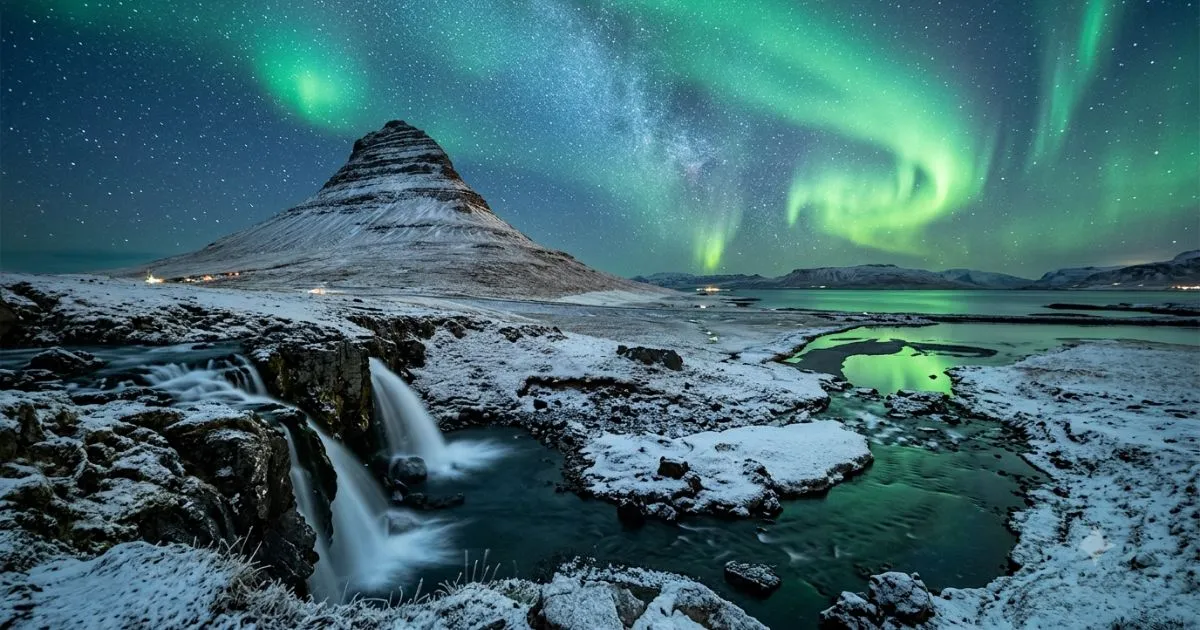
It’s 1 AM. You are standing on a black sand beach in -8°C, and the entire sky just exploded in green. Ribbons of light dance, pulse, and drip toward the horizon like someone spilled cosmic paint. This is not a documentary. This is Iceland from September to April. The problem is, 60% of tourists who fly to Iceland for the Northern Lights never see them. They pick the wrong month, stay in Reykjavik, or give up after one cloudy night. This guide fixes that. You will learn exactly when to go, the 10 best places with GPS coordinates, how to read a real aurora forecast, camera settings that work, and the exact 7-day route that gives you a 90% chance. Read this once, and you hunt like a local.
Table of Contents
- 1. What Are the Northern Lights?
- 2. Best Time: Month, Week, and Hour Breakdown
- 3. 10 Best Places in Iceland to See Aurora
- 4. How to Read Aurora & Cloud Forecasts Like a Pro
- 5. Photography: Mobile and DSLR Settings
- 6. Tours vs Self-Drive: Cost & Which to Choose
- 7. Packing List for -15°C Aurora Hunts
- 8. 7-Day Ring Road Aurora Itinerary
- 9. 7 Mistakes That Ruin Your Trip
- 10. FAQ
1. What Are the Northern Lights?
The Northern Lights, or aurora borealis, are the result of a space weather event. The sun constantly releases charged particles called solar wind. When that wind reaches Earth, our magnetic field funnels it toward the poles. Those particles hit oxygen and nitrogen atoms 80 to 400 km above us. The atoms get excited and release photons, which we see as light. Oxygen produces green and red. Nitrogen creates blue and purple. That is the science in 30 seconds.
Iceland sits at 64°N to 66°N, directly under the auroral oval. The oval is a ring of aurora activity around the magnetic pole. Countries like Scotland or Canada only see aurora when KP index is 5 or higher. In Iceland, KP 2 is often enough for a visible show. That is why Iceland has the best effort to reward ratio for aurora hunters. You do not need a solar storm. You just need darkness and clear skies.
2. Best Time: Month, Week, and Hour Breakdown
You need two things for aurora: darkness and clear skies. Iceland has midnight sun from May 20 to August 20. There are zero auroras in summer. The season runs September 1 to April 15. But not every month is equal.
Month by Month Analysis
| Month | Hours of Darkness | Aurora Chance | Weather & Road Notes | Verdict |
|---|---|---|---|---|
| September | 6-10 hours | Medium | 10°C, all roads open, autumn colors | Best for photographers. Milky Way + Aurora in one frame. |
| October | 10-14 hours | High | 5°C, first snow, F-roads start closing | Perfect balance of darkness and access. |
| November | 14-18 hours | High | 0°C, storms begin, daylight 9am-4pm | Great darkness but weather is risky. |
| December | 18-20 hours | Highest | -5°C, shortest day Dec 21, ice on roads | Max darkness. Christmas lights + aurora. Tough driving. |
| January | 17-19 hours | Highest | -5°C, ice cave season, many roads closed | Best odds but coldest. Need 4×4 and experience. |
| February | 14-17 hours | High | -2°C, snow storms common | Locals love Feb. Good darkness, slightly more light. |
| March | 10-14 hours | High | 0°C, Spring Equinox boosts activity 25% | Best month overall. Equinox + decent weather. |
| April | 5-10 hours | Low | 3°C, season ends April 15 | Only go first week. After 10th, sky is too bright. |
Best Week: Use the Moon
A full moon is 100 times brighter than a KP 2 aurora. It will wash out weak displays. Plan your trip around the new moon. For 2026, the best new moon dates are: Sep 10, Oct 9, Nov 8, Dec 7, Jan 6, Feb 4, Mar 5, Apr 4. Book your trip so the middle of your stay hits new moon plus or minus 3 days.
Best Hour: 9 PM to 2 AM
Data from the Icelandic Meteorological Office shows 11 PM to 1 AM has the highest frequency. But if KP is 5 or higher, aurora can start at 7 PM. Set an alarm for 10 PM, 12 AM, and 2 AM. Check outside each time.
3. 10 Best Places in Iceland to See Aurora
The rule: be away from lights and have a clear view north. Here are 10 spots ranked by photo potential and accessibility. Want the full driving plan? See our 7-Day Iceland Ring Road Itinerary for how to connect these.
Kirkjufell & Kirkjufellsfoss, Snæfellsnes
GPS: 64.9261°N, 23.3119°W | KP Needed: 2+ | Drive from Reykjavik: 2.5 hours
This is Iceland’s most photographed mountain. The waterfall gives you foreground. Because it faces north, you do not need to climb. Park, walk 2 minutes, shoot. Downside is crowds. Arrive by 9 PM to get tripod space.
Jökulsárlón Glacier Lagoon & Diamond Beach
GPS: 64.0480°N, 16.1794°W | KP Needed: 3+ | Drive: 5 hours
Aurora reflects on icebergs in the lagoon. Walk across the road to Diamond Beach for ice chunks on black sand. This is the number one shot on Instagram. Check tides and never turn your back on the ocean.
Stokksnes & Vestrahorn
GPS: 64.2545°N, 14.9644°W | KP Needed: 2+ | Entry: 900 ISK
Private land, so it is never crowded. The black dunes flood at high tide and create a perfect mirror. You can get mountain, reflection, and aurora in one frame. The Viking Village cafe is open till 10 PM for a warm break.
Reynisfjara Black Sand Beach, Vík
GPS: 63.4045°N, 19.0446°W | KP Needed: 3+ | Warning: Sneaker waves
Basalt columns and Reynisdrangar sea stacks make a dramatic frame. Do not go near the water at night. Waves are deadly. Shoot from the upper parking lot if KP is high.
Goðafoss, North Iceland
GPS: 65.6828°N, 17.5500°W | KP Needed: 3+
Waterfall of the Gods. It is wide, powerful, and faces north. There are viewing platforms on both east and west sides. The east side is better for aurora. Path can be icy. Use crampons.
Þingvellir National Park
GPS: 64.2558°N, 21.1295°W | KP Needed: 3+ | Drive: 45 min
UNESCO site where tectonic plates meet. Hakid viewpoint has parking and zero light pollution. You are shooting aurora over a rift valley. The ultimate geology plus astronomy combo.
Ásbyrgi Canyon
GPS: 66.0150°N, 16.5070°W | KP Needed: 2+
Horseshoe shaped canyon in North Iceland. The 100m cliffs block wind and light from the south. It feels like a natural amphitheater for the sky. Camping area open year round.
Landmannalaugar
GPS: 63.9820°N, 19.0609°W | KP Needed: 3+ | Access: Sep only, 4×4 required
Highlands with rainbow rhyolite mountains. The minerals reflect green and pink aurora, making the whole landscape glow. F208 road is rough. Only attempt if you have highland driving experience.
Westfjords: Rauðasandur
GPS: 65.4480°N, 24.0300°W | KP Needed: 2+
A red sand beach in the remote Westfjords. Population near zero, so light pollution is zero. The road 612 is gravel and often closed in winter. Best for summer or September trips.
Grótta Lighthouse, Reykjavik
GPS: 64.1644°N, 22.0222°W | KP Needed: 4+ | Bus: 11
Your backup plan. If you are stuck in Reykjavik, this is the darkest spot in the city. You need KP 4 to see anything. Island is closed during bird nesting May-July. Check opening hours.
4. How to Read Aurora & Cloud Forecasts Like a Pro
Stop using generic aurora apps. You need three data points. If one fails, you stay inside.
1. Cloud Cover: vedur.is
The Icelandic Met Office Aurora Forecast is your bible. White means clear sky. Green means cloud. Check the map at 6 PM, 9 PM, and 12 AM. Cloud moves fast. A spot that is covered at 9 PM can be clear at 11 PM.
2. Geomagnetic Activity: KP Index
KP runs 0 to 9. For Iceland: KP 0-1 means nothing. KP 2 means camera only. KP 3 means visible to eye at dark sites. KP 4 means visible from suburbs. KP 5+ means overhead storm. Use the Aurora Forecast app or SpaceWeatherLive for 3-day KP predictions.
3. Solar Wind: Bz Value
This is the secret. Bz is the direction of the solar magnetic field. When Bz is negative, called Bz south, it connects with Earth and causes aurora. Bz -10nT or lower is great. You can see live Bz data on SpaceWeatherLive. If KP is 3 but Bz is +10, you will see nothing. If KP is 2 but Bz is -15, you might get a surprise show.
The Rule: KP 3+ AND Clear Sky AND Bz Negative = Get in the car.
5. Photography: Mobile and DSLR Settings
Your eyes see a faint gray cloud. Your camera sees color. Here is how to capture it.
Mobile Phone
- iPhone 14 Pro or newer: Night Mode, 10s exposure, use a tripod. Tap the moon icon and slide to Max. Turn on ProRAW for editing.
- Samsung S23 Ultra: Pro Mode, ISO 1600, 10s, WB 3800K. Use Expert RAW app for 30s exposures.
- Rule for all phones: No tripod means no photo. Buy a $20 phone tripod. Turn off flash.
DSLR / Mirrorless
| Setting | Start Here | Why |
|---|---|---|
| Lens | 14-24mm f/2.8 | Wide and fast. Captures sky + landscape. |
| Mode | Manual | Auto will fail in dark. |
| Aperture | f/2.8 | Widest lets in most light. |
| Shutter | 8 seconds | If aurora moves fast, use 3-5s. If slow, use 15s. |
| ISO | 1600 | Start here. Go to 3200 if dark. 6400 if desperate. |
| Focus | Manual, infinity | During day, focus on a cloud. Tape the focus ring. |
| White Balance | 3800K | Keeps green accurate. Auto makes it yellow. |
Composition Tip: Never shoot just sky. Put a church, waterfall, person, or mountain in the frame. It gives scale. For a person, have them stand still for the full exposure and light them with a headlamp for 1 second.
6. Tours vs Self-Drive: Cost & Which to Choose
Aurora Tour
Cost: $70 to $150 per person. Duration: 4-6 hours.
Pros: Guide drives on ice, knows micro-climates, has free retry if you see nothing. Many provide tripods and hot chocolate. You can sleep on the bus.
Cons: You leave at 9 PM and are back by 1 AM no matter what. If aurora starts at 2 AM, you miss it. You share the spot with 30 people.
Book if: You do not rent a car, you are nervous about winter driving, or you only have 2 nights.
Self-Drive
Cost: 4×4 rental $120 per day + gas $30 per day.
Pros: Total freedom. If clouds roll in, you drive 2 hours to clear sky. You can stay at one spot from 8 PM to 4 AM.
Cons: Iceland winter driving is serious. Roads have ice, wind, and no lights. You need to read forecasts yourself.
Do it if: You have winter driving experience and are staying 5+ nights.
Pro Strategy: Book one bus tour on night 2. Learn from the guide. Then self-drive the other nights. Get forecast data from NOAA 30-Minute Forecast to time your outings.
7. Packing List for -15°C Aurora Hunts
People quit at 11 PM because they are cold, not because aurora stopped. Dress right and you can stay out for 4 hours.
- Base Layer: Merino wool top and bottom. Not cotton. Cotton kills.
- Mid Layer: Fleece jacket or down sweater.
- Outer Layer: Waterproof, windproof shell jacket and pants. Gore-Tex is worth it.
- Feet: Wool socks + insulated waterproof boots. Add microspikes for ice at waterfalls.
- Hands: Thin liner gloves for camera use, plus thick ski mittens over them.
- Head: Wool hat that covers ears, plus a balaclava or neck gaiter.
- Extras: Hand warmers, toe warmers, thermos with tea, red light headlamp to keep night vision, power bank because cold kills batteries.
8. 7-Day Ring Road Aurora Itinerary
This route hits all the top spots and maximizes your nights under dark sky. Total drive ~1350 km. Do this in Sep-Oct or March for best road conditions.
Day 1: Arrival & Reykjanes Land at KEF, pick up 4×4. Soak at Blue Lagoon. If clear, hunt at Grótta Lighthouse. Sleep Reykjavik.
Day 2: Golden Circle Þingvellir, Geysir, Gullfoss. Sunset at Bruarfoss. Hunt near Flúðir. Sleep Hella.
Day 3: South Coast to Vík Seljalandsfoss, Skógafoss, Kvernufoss. Dyrhólaey arch at sunset. Hunt at Reynisfjara. Sleep Vík.
Day 4: Jökulsárlón Day Drive to Skaftafell, Svartifoss hike. Evening at Jökulsárlón and Diamond Beach. This is your main photo night. Sleep Höfn.
Day 5: East Fjords Drive the fjords to Egilsstaðir. Stop at Vestrahorn/Stokksnes on the way. Hunt near Seyðisfjörður. Sleep Egilsstaðir.
Day 6: North Iceland Dettifoss, Mývatn geothermal area, Goðafoss at sunset. Hunt at Goðafoss or Aldeyjarfoss. Sleep Akureyri.
Day 7: Snæfellsnes & Return Drive 4 hours to Kirkjufell. Shoot sunset. Hunt until 1 AM. Drive 2.5 hours back to Reykjavik. Fly out day 8.
9. 7 Mistakes That Ruin Your Trip
- Only booking 2-3 nights: Statistics say you need 6-7 nights in Iceland from Sep-Apr for 90% chance. Weather is the boss.
- Staying in Reykjavik city center: Light pollution is too strong. You need to drive 30 min minimum.
- Ignoring cloud cover: KP 7 means nothing under clouds. vedur.is cloud map is more important than KP.
- Going out too early: 7 PM is usually too bright. Wait until 9 PM astronomical dark.
- Full moon trip: It washes out faint aurora. Book around new moon.
- Bad footwear: Sneakers on ice at Goðafoss = hospital trip. Bring crampons.
- Dead batteries: Cold drains batteries 5x faster. Keep spares in your inner jacket pocket.
10. FAQ
Can I see Northern Lights in Reykjavik?
Yes, but only during strong KP 5+ geomagnetic storms. For KP 2-4, drive to Grótta Lighthouse or Þingvellir. The city glow makes faint aurora invisible.
What is the best month to see aurora in Iceland?
March and October. You get 10-14 hours of darkness, Spring/Fall Equinox boosts solar activity, and weather is better than deep winter. December has most darkness but worst storms.
Are Northern Lights guaranteed?
No tour or location can guarantee them. They are natural. But if you stay 6+ nights between Sep-Apr and chase clear skies, your odds are over 90%.
Do I need to book a tour?
Not if you rent a car and are comfortable driving on ice at night. Tours are best for solo travelers or people with only 1-2 nights. Self-drive is best for photographers.
Can I see aurora with my phone?
Yes. Modern phones like iPhone 15 Pro and Galaxy S24 Ultra can capture aurora in Night Mode. You must use a tripod and 10 second exposure. It will not look like DSLR shots, but you will get color.
Is a glass igloo hotel worth it?
For the experience, yes. For aurora hunting, no. They cost $500+ per night and are often in areas with some light pollution. You are stuck in one spot. It is better to spend that money on a 4×4 and be mobile.
Final Word: Patience Wins
The Northern Lights are not on a schedule. They do not care about your flight time. Success comes from putting yourself in the right place at the right time, for many nights in a row. Use this guide. Check vedur.is every evening. Dress warm. Be patient. When that first green arc appears and starts to dance, every frozen minute becomes worth it. Clear skies, or as Icelanders say, Skýr á lofti.
Have questions? Drop them below. If you saw aurora in Iceland, tell me where and what KP it was. It helps other readers.