

The “Cockroach” Revolution: How an Insult Became a Gen-Z Political Movement
Introduction
In May 2026, a single word used inside a courtroom in New Delhi traveled far beyond its walls. Within days, it appeared on Instagram bios, protest placards, and memes in multiple languages.
That word was “cockroach.” What followed has been described by several Indian news outlets as the “Cockroach Revolution” or the “Cockroach Janta Party” movement — a decentralized, youth-led wave of digital satire and street protest that turned a pejorative into a political identity.
This article explains what the term means, where it came from, how it spread, and why it matters for understanding modern youth politics, without supporting or opposing any party or ideology.
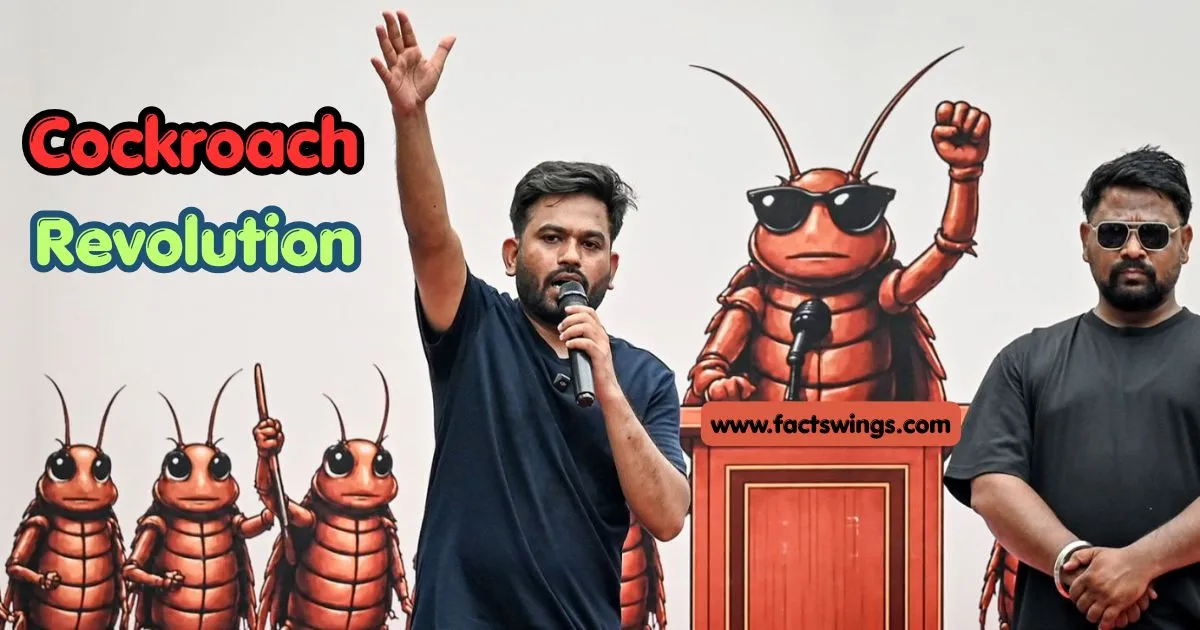
What Does “Cockroach Revolution” Mean?
The phrase “Cockroach Revolution” is not an official name of a registered political party. It is a colloquial label used by media and participants to describe a protest phenomenon that began in India in mid-2026.
In this context, it refers to two things:
- A symbolic reappropriation: Young people adopting an insult — “cockroach” — as a badge of collective identity.
- A method of protest: A blend of meme culture, satirical branding, and limited offline actions such as cleanliness drives and permitted sit-ins.
Similar reappropriation has been observed in other movements globally, where groups reclaim derogatory terms to build solidarity.
Origins of the Term
According to multiple news reports and a Wikipedia entry citing court proceedings, the origin is linked to a hearing in the Supreme Court of India in May 2026.
The case involved a contempt plea related to the Delhi High Court’s process for designating senior advocates. During the hearing, a bench led by Chief Justice of India Surya Kant was reported to have reprimanded a lawyer for intemperate social media language.
“There are youngsters like cockroaches; they don’t get any employment, and they don’t have any place in a profession. Some of them become media, some of them become social media, some of them become RTI activists…” — Reported remark attributed to CJI Surya Kant, as widely quoted in news reports in May 2026
The Chief Justice later issued a clarification, stating that his remarks had been misquoted and that he was specifically criticizing individuals who allegedly used fake degrees to enter noble professions, not India’s youth in general. He added that he held India’s youth in high regard.
Despite the clarification, the word “cockroach” and the word “parasites,” which was also reported in the same exchange, circulated widely online.
How an Insult Became a Symbol
The transformation from insult to symbol happened in three reported stages:
- Outrage: Clips and quotes from the hearing were shared on X and Instagram, with many young users saying they felt dismissed over concerns about unemployment and exam irregularities.
- Reclamation: On May 16, 2026, Abhijeet Dipke, a 30-year-old graduate in public relations from Boston University who had previously been associated with political communication work, announced the formation of a satirical platform called the Cockroach Janta Party (CJP).
- Spread: The name, which rhymes with an established national party’s name, was described by analysts as intentionally provocative and meme-friendly. Hashtags such as #MainBhiCockroach trended.
According to reports, the movement’s official accounts claimed millions of followers within days and offered free digital ID cards as a form of participation. Independent verification of exact follower numbers is difficult because social media metrics fluctuate and can include inactive accounts.
The Role of Gen Z
Participants and observers have described the movement as Gen Z-led. This aligns with broader research on Generation Z political behavior.
According to Pew Research Center, Gen Z is the most racially diverse generation and the first to grow up with smartphones from an early age. Researchers note they tend to favor visual storytelling, irony, and decentralized organization.
In this case, Gen Z tactics reported included:
- Creating state-wise handles (e.g., CJP Maharashtra) without central coordination
- Using Instagram Reels, memes, and pop-culture templates rather than traditional manifestos
- Organizing low-barrier offline acts, such as a reported Yamuna riverbank cleanliness drive where participants wore “I am a cockroach” placards
To understand the broader generational context, see this overview of Generation Z characteristics and political behavior.
Why Social Media Accelerated the Movement
Several factors explain the rapid online spread:
| Factor | How It Worked |
|---|---|
| Low barrier to entry | Sharing a meme or changing a bio was easier than attending a formal meeting. |
| Visual language | Short videos and ID cards were optimized for Instagram Stories and WhatsApp. |
| Algorithmic amplification | Humor and outrage both tend to receive higher distribution on engagement-based platforms. |
| Perceived media gap | When participants felt mainstream coverage was limited, they used direct-to-audience channels. |
Researchers of digital activism have noted similar patterns in other youth movements, including those in Nepal in 2025 where social media bans triggered mass mobilization on alternative platforms like Discord.
Political Symbolism Explained
The cockroach, in political rhetoric, has a long and controversial history. Dehumanizing language has been used in various conflicts to marginalize opponents, and its use is widely criticized by human rights groups.
In this movement, participants inverted the meaning. Analysts suggest three symbolic layers:
- Survivability: Cockroaches are stereotyped as resilient and hard to eliminate, which participants linked to youth persistence despite unemployment.
- Invisibility: The insect lives unseen, which some supporters connected to feeling invisible in national discourse.
- Collectivity: The idea of a “swarm” was used to describe decentralized, leaderless action.
Political communication scholars note that reclaiming an insult can create strong in-group identity, but it can also risk reinforcing the original negative frame if taken out of context.
Public Reactions
Supporters’ Perspective
Supporters, including some student groups and public figures quoted in Indian media, said the movement gave voice to legitimate frustrations: exam paper leaks, particularly the NEET undergraduate medical entrance exam controversy in 2025-2026, youth unemployment, and perceived lack of institutional accountability.
They argued that satire was a non-violent way to demand transparency, and pointed to actions like peaceful sit-ins at Jantar Mantar in New Delhi — a historic protest site — after receiving permission.
Critics’ Perspective
Critics, including some commentators and government supporters cited in media reports, raised several concerns:
- That satirical branding trivializes serious policy issues.
- That decentralized movements lack clear accountability structures.
- That the movement’s rapid growth made it vulnerable to co-option or infiltration, as seen in allegations around clashes during a Parliament march attempt.
Some officials also characterized the protests as politically motivated. Independent observers noted that such characterizations are common in contentious protest environments and should be weighed against verifiable actions of participants.
International Media Coverage
The movement received coverage beyond India. Outlets including BBC and other international publications reported on the satirical nature of the party and its connection to broader Gen Z protest trends in South Asia.
According to Reuters style reporting standards, international coverage generally framed the movement as part of a larger wave of youth-led, internet-first activism seen in Sri Lanka, Bangladesh, and Nepal since 2022, while noting India’s distinct electoral and institutional context.
Coverage emphasized that India’s electoral system continues to function with competitive elections, which differentiates it from situations where elections were postponed or boycotted.
Lessons for Modern Democracy
Regardless of one’s view of the specific movement, analysts have drawn several neutral observations relevant to democracy:
- Language matters: Remarks by public officials, even when clarified, can have outsized impact in a networked age.
- Satire lowers participation costs: Humor can bring first-time participants into public life who might avoid traditional politics.
- Institutions need responsive channels: When formal grievance mechanisms are seen as slow, young people often create informal ones.
- Digital and physical spaces are linked: Viral moments rarely stay online; they can lead to permitted protests, clean-up drives, or, at times, confrontations with police.
For a comparative example of youth-led symbolic politics, see our profile of how Greta Thunberg used symbolism in youth activism.
Timeline: From Remark to Movement
- Early May 2026: Supreme Court hearing where reported “cockroach” and “parasites” comparison is made; clarification follows.
- May 16, 2026: Cockroach Janta Party announced by founder Abhijeet Dipke; #MainBhiCockroach trends.
- Late May – Early June 2026: Instagram growth claims, ID card generator, state-level handles emerge.
- June 6, 2026: Reported sit-in at Jantar Mantar, New Delhi, demanding accountability over exam irregularities.
- July 2026: Reports of attempted Parliament march, police action including tear gas, internet curbs around protest sites, and talks with government representatives.
Note: Dates are based on multiple news reports. Exact numbers of participants and injuries vary across sources.
Key Takeaways
- The Cockroach Revolution is a media label for a satirical, youth-driven protest phenomenon that began in India in May 2026.
- It originated after a controversial remark attributed to the Chief Justice of India, which was later clarified.
- Gen Z participants reappropriated the insult as a symbol of resilience and collective identity.
- Social media, especially Instagram, accelerated its spread through memes and low-barrier participation.
- The movement highlights broader trends in digital activism, political symbolism, and youth engagement with democratic institutions.
Frequently Asked Questions
What is the Cockroach Revolution?
It is a term used to describe a 2026 Indian youth protest wave where participants reclaimed the word “cockroach” — reportedly used to describe unemployed youth — as a satirical political identity, blending memes with street actions.
Is the Cockroach Janta Party a real political party?
No. As of July 2026, it is not registered with the Election Commission of India. It describes itself as a youth pressure front and satirical movement, not a formal electoral party.
Why did Gen Z adopt the cockroach symbol?
Supporters say it turns an insult into resilience. The cockroach is seen as a survivor that is hard to ignore, which they use to symbolize persistence despite unemployment and institutional distrust.
What were the protesters demanding?
According to reports, initial demands focused on accountability for NEET exam paper leaks and broader issues like youth unemployment and exam reform. Demands evolved as the movement grew.
How did social media help the movement?
Platforms lowered participation barriers. Memes, Reels, and digital ID cards made it easy to join visually. When mainstream attention was perceived as limited, social media provided direct outreach.
Has this kind of symbolism been used before?
Yes. Reclaiming insults is common in protest history. In Hong Kong in 2019, protesters were also labeled “cockroaches” by opponents, and some adopted the term ironically. Similar reappropriation occurred with other political labels globally.
What does this mean for modern democracy?
It shows how language, humor, and digital tools shape youth engagement. It underscores the importance of responsive institutions and the need to distinguish between satire, legitimate grievance, and misinformation.
Conclusion
The Cockroach Revolution is less about an insect and more about how a generation chooses to be seen. It began with a remark inside a courtroom, but its momentum came from a deeper set of concerns that many young Indians have expressed online and offline.
Whether one views the movement as effective satire or as an oversimplification of complex policy issues, its trajectory offers a case study in modern political communication: an insult, once repeated, can become an identity; a meme, once shared, can become a meeting point.
For democracies, the lesson is not whether to agree with the symbol, but to understand what made the symbol resonate — and what that resonance reveals about trust, opportunity, and the evolving language of protest.