

AI Infrastructure · Australia
Why Is Australia Investing Billions in AI Data Centres?
Artificial intelligence is creating a new demand for computing power. Australia is responding with a growing pipeline of large data-centre projects, new energy requirements and billions of dollars in potential investment.
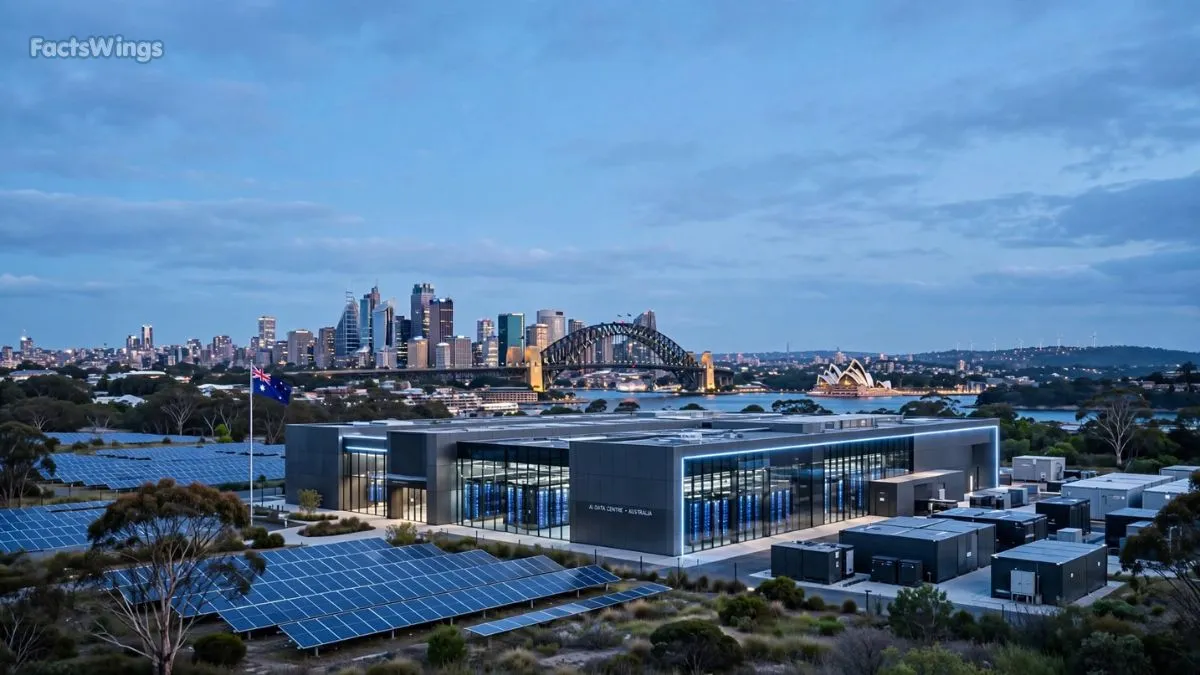
Australia is building a new kind of infrastructure boom. It is not a mining project or a housing cycle. It is a race to build the computing capacity needed for the next generation of artificial intelligence.
Data centres have existed in Australia for years. They store data, connect businesses to cloud services and provide computing power for digital products. But AI is changing the size and intensity of that demand.
Modern AI systems need powerful processors and large amounts of computing capacity. As businesses and consumers use more AI services, companies need more physical infrastructure behind those services.
The result is a rapidly growing pipeline of data-centre projects across Australia. The Australian Bureau of Statistics has also recorded a sharp rise in investment linked to data-centre equipment and construction.
The Real Reason Behind the Boom: AI Needs Physical Infrastructure
It is easy to think of AI as something that exists only on a screen. In reality, every large AI service depends on physical machines somewhere.
A data centre is essentially a highly specialised facility for computing. Inside are servers, processors, networking equipment, electrical systems, cooling equipment and security systems.
The Australian Bureau of Statistics describes data centres as facilities that house IT infrastructure for data storage, networking and processing. The ABS also notes that this processing power enables technologies such as artificial intelligence.
AI is therefore creating demand for the infrastructure underneath the software. More AI workloads mean more processors. More processors mean more electricity, cooling and network capacity.
How Big Is Australia’s Data-Centre Pipeline?
The scale of the proposed build-out is unusually large.
Commonwealth Bank analysis published in August 2026 estimated that Australia had around six gigawatts of potential data-centre capacity in its pipeline. That was roughly four times the operational capacity recorded at the end of 2025.
CommBank estimated that the build-out could represent around A$150 billion by 2030.
That number needs an important qualification. It is an estimate of potential investment associated with the pipeline. It does not mean Australia has already spent A$150 billion.
Some announced projects may be delayed, redesigned, reduced in size or never built. CommBank itself notes that not every project in the pipeline is expected to proceed at its proposed scale or original timeframe.
This distinction matters because headlines about infrastructure investment can easily make proposed spending sound like money that has already been invested.
Where Is the Investment Going?
Australia’s data-centre pipeline is spread across several states and territories. According to CommBank’s analysis, around half of the proposed capacity was in New South Wales and about a quarter was in Victoria, with growing interest in South Australia, Western Australia, Queensland and the Northern Territory.
Location matters because a data centre cannot simply be built anywhere. Developers need suitable land, strong telecommunications connections, access to electricity and a practical path to grid connection.
Water availability can also matter, depending on the cooling system used by the facility.
This is why Australia’s data-centre boom is becoming an infrastructure story as much as a technology story.
The $32 Billion Queensland Project
Western Downs Digital Park
ABC News reported on 16 September 2026 that AI company Anthropic had signed an agreement to use part of a proposed A$32 billion data-centre development in Queensland’s Western Downs.
The proposed project is near Dalby and is being developed by Zerra DC. The agreement is subject to approval from Australia’s Foreign Investment Review Board.
ABC reported that the proposed facility could draw as much electricity as around 1.5 million average Australian households.
The Queensland example helps explain why AI data centres are different from ordinary office buildings. A project of this scale can become a major electricity customer and can require supporting infrastructure far beyond the data-centre site itself.
It also shows how AI companies can become direct participants in the infrastructure race. Instead of simply renting small amounts of cloud capacity, major AI companies need access to large and reliable computing environments.
Why Electricity Has Become a Critical Issue
Data centres need electricity every day and, in many cases, around the clock. AI facilities can be especially demanding because powerful processors consume significant amounts of energy and produce heat that must be managed.
Australia’s electricity system is already changing as the country adds renewable generation, storage and new transmission infrastructure.
The new data-centre demand arrives at the same time.
A September 2026 Australian Government consultation paper cites Australian Energy Market Operator modelling that data-centre electricity consumption in the National Electricity Market could rise from about 5 TWh in 2025–26 to 34 TWh in 2035–36 under AEMO’s Step Change scenario.
Under that scenario, the share of electricity supplied through the grid used by data centres would rise from roughly 3 percent to approximately 13 percent.
These are scenario projections, not guaranteed future outcomes. But they show why governments and electricity-market regulators are paying much closer attention to data-centre growth.
Australia Wants New Data Centres to Bring New Energy
The Australian Government is developing national standards for large data centres and AI training infrastructure.
Its September 2026 consultation paper proposes that large data centres bring forward new renewable generation sufficient to offset their energy demand, with appropriate firming such as batteries, hydro or gas.
The proposed framework also includes demand flexibility and measures intended to reduce the risk that data-centre growth increases costs for other electricity users.
This approach reflects a basic problem: Australia wants more AI infrastructure, but it also needs a reliable electricity system that can serve households, hospitals, factories, offices and other businesses.
What About Renewable Energy?
Renewable energy is becoming an important part of the data-centre discussion because many technology companies want access to lower-emissions electricity.
Australia has significant solar and wind resources, but renewable generation is variable. Data centres, however, need reliable power.
That means new generation may need support from storage, transmission and other firming technologies.
The challenge is therefore not simply to build more solar panels or wind turbines. The system also needs to deliver electricity when the data centre requires it.
This is one reason data-centre development can influence investment in energy infrastructure as well as technology infrastructure.
Water Is Another Part of the Equation
Electricity is not the only resource that matters.
Data centres generate heat, and that heat must be removed. Some cooling technologies can use water, while other designs rely more heavily on air cooling or closed systems.
The amount of water used depends on the facility’s design, climate and cooling technology. It is therefore misleading to apply one water-use figure to every data centre.
Australia’s proposed AI infrastructure standards include water management. The government says large facilities should use water efficiently and avoid undermining water security.
For developers, this means location and engineering choices can become as important as the availability of land.
Could the Boom Create Jobs?
Large data-centre projects require workers during construction and operation. That can include electricians, engineers, network specialists, security teams, technicians, facilities managers and other skilled workers.
There can also be indirect activity. Construction companies, equipment suppliers, energy developers, telecommunications businesses and professional services may all become part of the wider project ecosystem.
The Queensland proposal illustrates the potential scale. However, employment numbers associated with proposed projects should be treated as estimates until projects receive approvals and move through construction.
There is also an important limitation. Data centres are highly automated facilities. A large investment figure does not automatically mean the same number of permanent jobs as a similarly sized labour-intensive industry.
Why Australia Wants More AI Infrastructure at Home
The investment is not only about commercial demand.
Australia also wants to develop stronger domestic capability in artificial intelligence.
The Australian Government has said secure, onshore infrastructure can support AI development, research, innovation, productivity and resilience.
Having more computing infrastructure inside Australia can also give businesses and researchers more options when they need to process sensitive or Australia-specific workloads.
It does not mean every AI service needs to run on Australian infrastructure. Global cloud providers will continue to operate international networks. But domestic capacity can give Australia greater control over part of its digital infrastructure.
There Is a Bigger Economic Story Behind the Numbers
The data-centre boom is already visible in official economic statistics.
In May 2026, the ABS reported that investment in data-centre equipment, including server racks and processing equipment, had significantly boosted overall private capital expenditure.
In August 2026, the ABS reported that data-centre construction and expansion continued to grow for an eighth consecutive quarter.
The ABS also reported that information media and telecommunications building investment rose in the June quarter, with continued activity on data-centre construction helping to expand capacity.
These figures are important because they show that the story is not limited to proposed projects. Investment connected with data centres is already appearing in Australia’s economic data.
But Billions in Investment Do Not Mean Billions in Australian GDP
There is another detail that is easy to miss.
A large data-centre investment does not mean every dollar stays in Australia.
CommBank noted that Australian businesses perform much of the construction, electrical and mechanical work, but specialised processors, AI chips, servers and networking equipment are generally imported.
That means a significant part of the value of a large data-centre project can flow overseas through imported equipment.
This is why investment value and economic output are not the same thing.
Australia can gain from construction, engineering, employment, energy infrastructure, technology capability and ongoing operations without the entire headline investment amount becoming domestic economic output.
The Government Is Trying to Set the Rules Before the Boom Gets Bigger
Australia is now developing a national framework for large data centres and AI training infrastructure.
The September 2026 consultation paper covers issues including energy, water, location, community benefits and workforce impacts.
The consultation is scheduled to close on 9 October 2026.
The policy challenge is straightforward to describe but difficult to solve: Australia wants to attract investment and build AI capability without allowing rapid data-centre growth to create avoidable pressure on electricity, water or communities.
What Could Happen Next?
Australia’s data-centre pipeline is likely to remain closely connected to the global AI industry.
But a large pipeline does not guarantee that every project will be built. Developers still need financing, approvals, electricity connections, suitable land, network access and, in some cases, foreign investment approval.
Electricity availability may become one of the biggest constraints.
If several very large projects seek connections in the same region, the electricity network may need significant upgrades or additional generation and storage.
That means the future of Australia’s AI infrastructure will depend on more than the demand for AI. It will also depend on whether physical infrastructure can grow at the same speed.
What Does This Mean for Everyday Australians?
Most people will never visit a data centre. But many already use services supported by them.
Cloud storage, online banking, business software, digital platforms and AI assistants all depend on computing infrastructure.
If Australia expands its domestic capacity, businesses and researchers may gain access to more local computing resources. The construction boom can also support jobs and related infrastructure.
At the same time, Australians have a reason to pay attention to the resource side of the story. Electricity, water and land are not unlimited.
The central question is therefore not simply whether Australia should build AI data centres. It is how quickly they should grow, where they should be located and how the supporting infrastructure should be developed.
The Bottom Line
Australia’s AI data-centre boom is the physical side of the artificial intelligence revolution.
AI models may look like software, but they require buildings, processors, networks, cooling systems and enormous amounts of electricity.
Australia’s current pipeline is large. Commonwealth Bank estimates around six gigawatts of potential capacity and around A$150 billion of possible investment by 2030. The ABS is already recording strong data-centre-related investment, while the proposed A$32 billion Western Downs project shows the extraordinary scale of individual developments.
But the biggest story may be what happens around those buildings.
Australia will need to connect new electricity generation, strengthen networks, manage water carefully, develop technical skills and create rules that allow investment while protecting broader infrastructure needs.
The AI race is therefore becoming an infrastructure race. For Australia, the next few years will show whether the country can turn a huge pipeline of proposed computing capacity into reliable infrastructure that supports the wider economy.
Sources & Evidence
The figures and claims in this article were checked against Australian government statistics, official policy documents, industry analysis and established Australian reporting.
- Australian Bureau of Statistics — June 2026 capital expenditure release
- Commonwealth Bank — Australia’s data centre boom and A$150 billion estimate
- Australian Government — AI infrastructure consultation paper
- ABC News — Anthropic agreement for proposed Queensland data centre
Investment pipelines, forecasts and proposed projects can change. A pipeline estimate is not the same as money already invested, and proposed projects may be changed, delayed or cancelled. Readers should check the original sources for the latest position.
Frequently Asked Questions
Editorial note: This article reflects publicly available information available in September 2026. Forecasts and proposed infrastructure projects can change as approvals, financing, energy connections and project plans develop.