

Joan of Arc: The 17-Year-Old Who Led an Army
Introduction
In the spring of 1429, France was on the verge of collapse. An English army and its Burgundian allies held Paris and much of the north. The uncrowned king, Charles VII, was isolated in the Loire Valley, his treasury empty, his authority questioned.
Into this crisis came a teenager who could not read or write, who had never led troops, and who said she had been sent by God.
Her name was Jeanne d’Arc. History knows her as Joan of Arc, the Maid of Orléans. Within a year, she would lift a siege that had lasted seven months, lead an army to a string of victories, and see a king crowned. A year after that, she would be burned as a heretic at age 19.
Who Was Joan of Arc?
Joan of Arc (French: Jeanne d’Arc) was born around January 6, 1412, in the small village of Domrémy, on the border between the Duchy of Bar and the Kingdom of France. She died on May 30, 1431, in Rouen.
She was a peasant girl, later a military commander, later a condemned heretic, and finally a saint. Today she is a patron saint of France and one of the most studied women in medieval history.
Her life is exceptionally well-documented for a medieval peasant because both her condemnation trial and her rehabilitation trial left extensive transcripts.
Quick Facts About Joan of Arc
| Detail | Information |
|---|---|
| Born | c. January 6, 1412, Domrémy, France |
| Died | May 30, 1431 (aged approx. 19), Rouen |
| Also Known As | The Maid of Orléans, La Pucelle |
| Parents | Jacques d’Arc (farmer) and Isabelle Romée |
| Famous For | Lifting the Siege of Orléans (1429) |
| Beatified | April 18, 1909 by Pope Pius X |
| Canonized | May 16, 1920 by Pope Benedict XV |
| Feast Day | May 30 |
Early Life
Joan was the youngest of five children in a relatively prosperous peasant family. Her father, Jacques d’Arc, held the position of village dean, a local official responsible for collecting taxes and organizing defense.
Domrémy was vulnerable. During the Hundred Years’ War, villages could change hands quickly. Joan’s village was loyal to the Armagnac faction supporting Charles VII, surrounded by Burgundian territory. Villagers, including Joan’s family, had to abandon their homes at least once under threat of raids.
She was not taught to read or write, which was typical. Her mother, Isabelle Romée, a deeply pious woman, taught her prayers and the Catholic faith. Contemporary testimony describes Joan as hardworking, skilled in sewing, and known for her piety and charity.
France During the Hundred Years’ War
To understand Joan, you must understand the war. The Hundred Years’ War (1337-1453) was a long struggle between England and France over the French throne.
By 1420, France was shattered. King Charles VI, who suffered periods of insanity, disinherited his own son under the Treaty of Troyes. The treaty recognized King Henry V of England as heir to France and regent. When both Henry V and Charles VI died in 1422, the infant Henry VI of England was proclaimed king of both realms.
The Dauphin, Charles, the disinherited son, controlled only a small territory around Bourges. Many called him the “King of Bourges.” His claim was dismissed by many as illegitimate. English forces under John, Duke of Bedford, held Paris and northern France with Burgundian support.
The Visions That Changed Her Life
According to her own testimony during her trial, Joan began hearing voices at age 13, around 1425. She said the voices came from St. Michael the Archangel, St. Catherine of Alexandria, and St. Margaret of Antioch.
It is important to distinguish three layers here:
- Joan’s testimony: She stated the voices were sent by God to guide her to save France and see Charles crowned.
- Contemporary belief: In medieval France, divine visions and mystical experiences were widely accepted as possible.
- Modern interpretations: Historians continue to debate. Some scholars focus on the religious context; others have proposed medical or psychological explanations. There is limited historical evidence to definitively prove any single modern diagnosis, and the Catholic Church considers her experiences as part of her sanctity.
By 1428, she said the voices became insistent: she must go to the Dauphin and expel the English. She also took a private vow of chastity.
Meeting Charles VII
In May 1428, Joan asked her relative Robert de Baudricourt, commander of the nearby fortress of Vaucouleurs, to take her to Charles. He refused and mocked her. She persisted.
On her second attempt in January 1429, after a prophecy about a maid from Lorraine circulated, Baudricourt relented. He gave her an escort and a horse. She cut her hair, dressed in men’s riding clothes for practicality and safety, and made an 11-day journey through enemy territory to Chinon, where Charles was residing.
Charles was cautious. He had advisors question her and had her examined by clergy at Poitiers and by women who confirmed her virginity. According to surviving accounts, she impressed him in a private audience, reportedly revealing information she could not have known — though details of that conversation remain unknown.
Convinced of her orthodoxy and sincerity, Charles gave her a place in a relief army being sent to Orléans. She was about 17 years old.
The Siege of Orléans
Orléans was the key. The city on the Loire River had been besieged by the English since October 12, 1428. If it fell, the English would have a gateway to southern France and Charles’s cause would likely collapse.
The English had not fully encircled the city but had built a ring of fortified outposts called bastilles that blocked supplies. The defenders were exhausted after seven months.
Joan arrived on April 29, 1429, entering from the eastern side with a convoy of supplies while French feints distracted the English on the west. Her arrival itself boosted morale. The citizens and soldiers saw it as fulfillment of prophecy.
How a 17-Year-Old Led an Army
Joan held no formal military rank. Her role was unique. According to commanders like Jean d’Alençon and Jean de Dunois, the Bastard of Orléans, she did not devise complex tactics but provided strategic clarity and moral force.
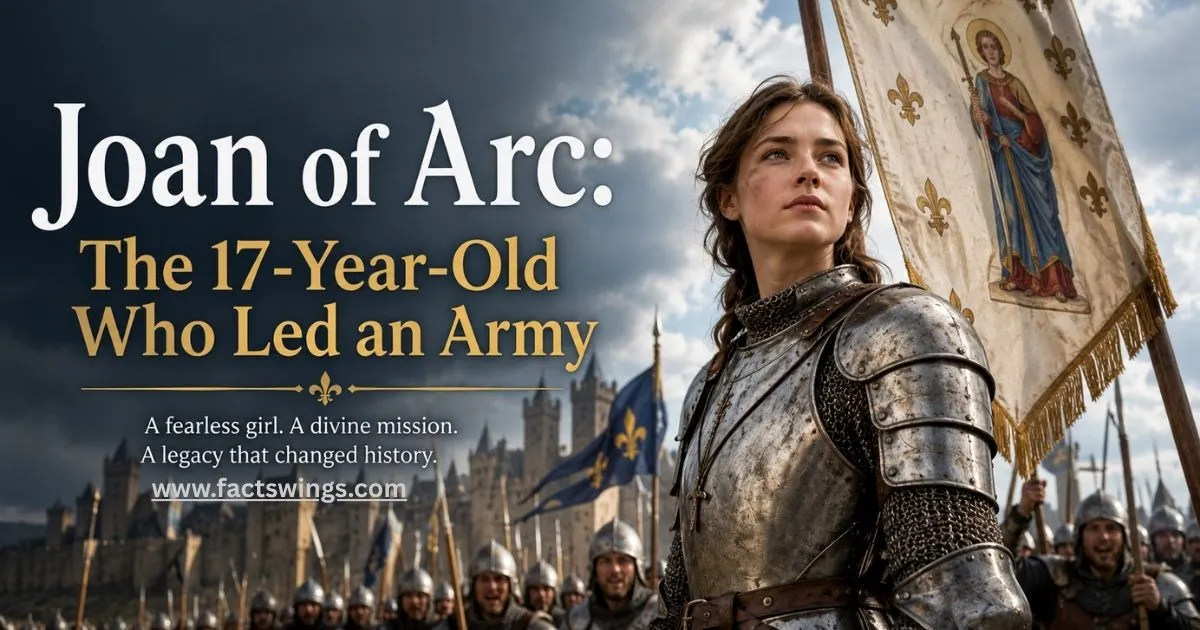
She urged aggressive action where commanders favored caution. She carried her own banner, which bore the words “Jesus Maria” and images of God and angels, and insisted on leading assaults rather than directing from the rear.
On May 4, the French took the bastille of Saint-Loup. On May 6-7, they assaulted Les Augustins and Les Tourelles. Joan was wounded by an arrow between the neck and shoulder on May 7 but returned to the fight after dressing the wound.
“In all she did, except in affairs of war, she was a very simple young girl; but for warlike things bearing the lance, assembling an army, ordering military operations, directing artillery, she was most skillful.” — Jean, Duke of Alençon, comrade-in-arms, testimony at rehabilitation trial
On May 8, 1429, the English, demoralized and short of supplies, abandoned the siege. They had held it for seven months. Joan had broken it in nine days.
Military Leadership and Strategy
After Orléans, Joan pushed for rapid advance. Over the next five weeks, the French Loire Campaign achieved stunning successes: Jargeau (June 12), Meung-sur-Loire (June 15), and Patay (June 18), where English commander Sir John Talbot was captured.
Her strategy was simple and effective: maintain momentum, attack aggressively, and use artillery innovatively. Modern historians note that her greatest impact may have been psychological — she shattered the myth of English invincibility that had persisted since Agincourt in 1415.
Her story is often compared to other historical figures who used symbolism to mobilize people, which you can explore further in our feature on how insult became symbol in modern movements.
Coronation of Charles VII
Joan insisted Charles must be crowned at Reims, the traditional site of French coronations, deep in enemy territory. The march was a political masterstroke — a coronation would legitimize his claim.
The Loire victories cleared the way. The city of Reims surrendered without a fight. On July 17, 1429, Charles VII was crowned in Reims Cathedral, with Joan standing beside him holding her banner.
Capture by the Burgundians
After the coronation, Charles’s political caution returned. He pursued truces. Joan wanted to press on to Paris, which failed in September 1429.
On May 23, 1430, while defending Compiègne against a Burgundian siege, Joan was pulled from her horse outside the town gates and captured by Burgundian forces under John of Luxembourg.
The Burgundians, allied with England, sold her to the English for 10,000 livres tournois — a huge sum at the time, roughly equivalent to the price of hundreds of warhorses.
The Trial
Joan was taken to Rouen, the administrative capital of English France. She was tried not by a secular court, but by an ecclesiastical court led by Bishop Pierre Cauchon, a supporter of the English cause.
The Trial of Condemnation ran from January 9 to May 29, 1431. It was politically motivated: if Joan was proven a heretic, Charles VII’s coronation could be discredited as achieved through a witch.
She was imprisoned not in a Church prison with female attendants, as was customary, but in the English military castle of Rouen under the guard of English soldiers. She was kept in irons.
Charges included heresy, witchcraft, and cross-dressing. Joan defended her male clothing as practical for riding, fighting, and protecting her modesty in a male prison. She defended her visions with remarkable composure and intelligence, despite being questioned for months by dozens of theologians from the University of Paris.
Execution at Rouen
On May 24, 1431, under threat of immediate execution, Joan signed an abjuration — a document renouncing her visions. She was sentenced to life imprisonment.
Days later, she resumed wearing men’s clothing, stating her voices had told her she had erred in abjuring. For the court, this made her a relapsed heretic.
On May 30, 1431, at about 19 years old, Joan was handed to secular authorities and burned at the stake in the marketplace of Rouen. Her ashes were cast into the Seine River.
Why Was Joan of Arc Burned at the Stake?
Officially, she was executed for heresy and for relapsing after abjuration. The specific theological issue was her insistence that her visions came from God and that she was subject to God before the Church on earth.
Politically, historians agree the English needed to discredit her military victories and delegitimize Charles VII. As noted by Encyclopaedia Britannica, the trial was deeply flawed and conducted by judges with clear conflicts of interest, many on the English payroll.
Rehabilitation Trial
After the English were expelled from France, Charles VII, now secure, requested a re-examination. In 1455, Pope Callixtus III authorized a new investigation led by Jean Bréhal, Inquisitor General of France.
The Rehabilitation Trial in 1456 interviewed over 100 witnesses who had known Joan. It concluded the original trial was corrupt, politically motivated, and had violated Church law. It noted judges were threatened, records tampered with, and Joan’s appeal to the Pope ignored.
On July 7, 1456, her conviction was annulled. She was declared innocent and a martyr.
Canonization as a Saint
Joan remained a folk saint for centuries. Following the French Revolution, her legacy was revived by Napoleon as a symbol of French patriotism.
In 1869, Bishop Félix Dupanloup of Orléans petitioned for formal canonization. She was beatified on April 18, 1909, by Pope Pius X and canonized on May 16, 1920, by Pope Benedict XV in St. Peter’s Basilica. Over 30,000 people attended, including 140 descendants of her family, according to Vatican records.
Her feast day is May 30.
Joan of Arc’s Legacy
Joan’s legacy is multifaceted. In France, she is a national heroine who helped create a sense of French identity. Militarily, she is studied for morale and momentum. Religiously, she is venerated as a mystic who obeyed what she believed was divine will.
She is also an early example of a woman exercising military command in medieval Europe, though her authority rested on charisma and perceived divine favor, not feudal right.
For those interested in how historians reconstruct ancient figures, our article on Herodotus and the birth of history writing explores similar challenges of evidence.
Interesting Facts About Joan of Arc
- No contemporary portrait of Joan made during her lifetime survives. All images are later interpretations.
- She signed her name as “Jehanne” — surviving examples show a shaky signature, suggesting limited literacy.
- Her banner, not her sword, was her most important symbol. She stated she loved her banner forty times more than her sword.
- She never killed anyone in combat, by her own testimony. She carried her banner and did not fight with weapons.
- The English used her male clothing as proof of heresy, but it also protected her in camp and prison.
- France was not fully liberated until 1453, 22 years after her death, at the end of the Hundred Years’ War.
- According to Smithsonian Magazine, analysis of the trial documents shows she was exceptionally quick-witted for her age and education.
- More than 10,000 books have been written about her, making her one of the most written-about women in history.
What Modern Historians Say
Modern historians generally agree on the core facts of her campaign, as documented by multiple sources. They continue to debate the nature of her visions and the extent of her tactical influence versus her symbolic impact.
As summarized by History.com, scholars note that whether viewed as saint, strategist, or symbol, her ability to inspire a demoralized army at age 17 remains historically remarkable.
There is consensus that her trial was a political trial cloaked in religious language, and that her rehabilitation reflected changing political realities as much as justice.
Timeline
Key Takeaways
- Joan of Arc was a peasant girl born around 1412 who, at 17, convinced the French court she was divinely sent to save France.
- Her leadership at the Siege of Orléans in May 1429 turned the tide of the Hundred Years’ War.
- She enabled the coronation of Charles VII at Reims, legitimizing his kingship.
- Captured by Burgundians in 1430 and sold to the English, she was tried by a pro-English ecclesiastical court and burned for heresy in 1431 at age 19.
- Her conviction was annulled in 1456, and she was canonized in 1920, becoming one of France’s patron saints.
Frequently Asked Questions
How old was Joan of Arc when she led the army?
She was about 17 when she arrived at Orléans in April 1429 and led French troops to lift the siege. She was 19 when executed.
What did Joan of Arc actually hear?
According to her trial testimony, she heard voices of St. Michael, St. Catherine, and St. Margaret. The Catholic Church treats this as part of her religious experience; historians continue to debate interpretations.
Why was Joan of Arc burned at the stake?
Officially for heresy and relapsing after abjuration, particularly for insisting her visions came from God. Politically, the English wanted to discredit Charles VII’s coronation.
Did Joan of Arc fight in battles?
She was present on battlefields carrying her banner and directing troops, was wounded by an arrow, but by her own account did not kill. Her role was inspirational and strategic rather than as a frontline fighter.
How did Joan of Arc die?
She was burned at the stake in the marketplace of Rouen on May 30, 1431, after being declared a relapsed heretic by an ecclesiastical court.
Was Joan of Arc really a saint?
Yes, in the Catholic Church. She was canonized on May 16, 1920, by Pope Benedict XV after a formal process that began in the 19th century. Her feast day is May 30.
What is the Siege of Orléans and why was it important?
A seven-month English siege of the key Loire River city, from October 1428 to May 1429. Its relief by Joan prevented the English from advancing into southern France and revived French morale.
Is there any real portrait of Joan of Arc?
No contemporary portrait from life survives. All images, including the 19th-century style miniatures, were created after her death based on descriptions.
Why is Joan of Arc still studied today?
She offers insight into medieval warfare, gender roles, religious belief, political propaganda, and national identity. Her well-preserved trial records are rare for a peasant woman of the period.
Conclusion
Joan of Arc’s life lasted less than twenty years, and her military career less than two. Yet her impact endures because she stands at the intersection of faith, politics, and personal conviction.
She was not a trained tactician, but she understood something her more experienced commanders had forgotten: that an army that believes it can win often does. By lifting the Siege of Orléans and ensuring a coronation at Reims, she gave France something it lacked — momentum and legitimacy.
Her execution was meant to erase that legacy. Instead, her rehabilitation and eventual canonization ensured her story would be retold for centuries, not as myth, but as a documented, deeply human story of a teenager who believed she had a mission and persuaded a kingdom to believe it too.