

GPT-10 Release in 2030: What We Know, What We Expect, and What It Means for the Future of AI
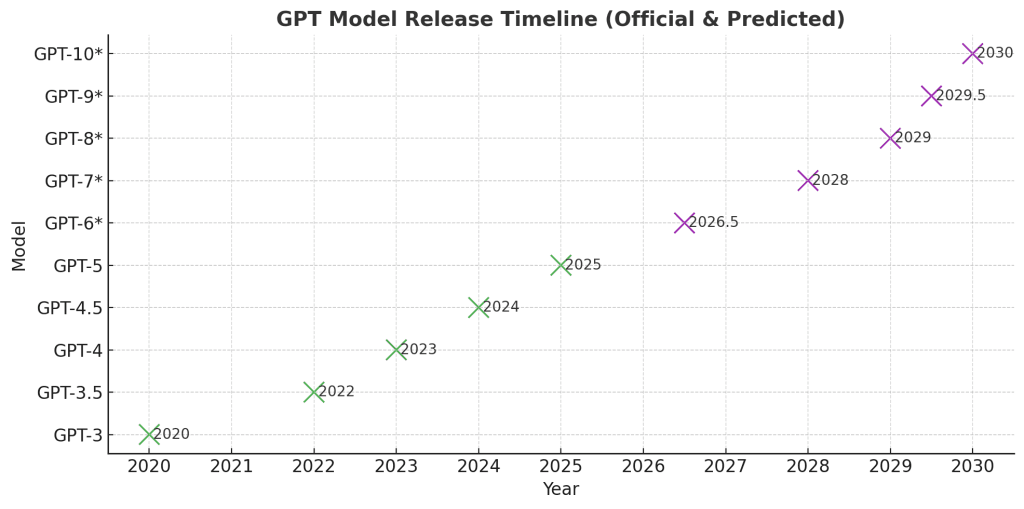
In the rapidly evolving landscape of artificial intelligence, few technological leaps have generated as much excitement, debate, and speculation as the release of new GPT models from OpenAI. Since the introduction of GPT-3 in 2020, each subsequent version has brought significant improvements in reasoning, language understanding, and multi-modal capabilities. With the latest official release being GPT-5 in August 2025, attention has already turned toward the distant but intriguing possibility of GPT-10, which—if current development trends hold—could arrive around 2030.
However, it’s important to be clear: there is no official confirmation from OpenAI about GPT-10’s existence or release date. Any suggestion of a 2030 launch is based on logical projections from historical patterns, industry pacing, and the trajectory of AI research. This article aims to outline what we actually know, avoid misleading speculation, and place the potential GPT-10 release in its proper context.
The Historical Timeline of GPT Models
To understand why many analysts predict a GPT-10 release around 2030, it helps to look at OpenAI’s track record:
- GPT-3 (2020) – A breakthrough in natural language processing, delivering coherent, human-like responses on a scale never before seen.
- GPT-3.5 (2022) – An incremental update, fine-tuned to make the technology more reliable for everyday use in ChatGPT.
- GPT-4 (2023) – A major leap forward, introducing multimodal capabilities (text and image input) and much improved reasoning skills.
- GPT-4.5 (2024) – Faster, more efficient, with better handling of complex prompts.
- GPT-5 (2025) – The current cutting edge, released in August 2025, offering stronger reasoning, broader knowledge coverage, and more advanced multi-modal features.
If we follow the trend of one major release every 1.5–2 years, the path from GPT-6 to GPT-10 would logically place GPT-10’s arrival in the late 2029 to 2030 range. But again, this is projection, not confirmation.
Why 2030 Makes Sense as a Projection
Several factors support the 2030 estimate:
- Research and Development Cycles – Large-scale AI models require extensive training, testing, safety evaluations, and infrastructure upgrades. These processes are not instantaneous, even for well-resourced organizations like OpenAI.
- Hardware and Compute Growth – Each new GPT generation demands exponentially more computing power. While advancements in GPUs, TPUs, and specialized AI chips are accelerating, building and optimizing the infrastructure for something on the scale of GPT-10 will take time.
- Regulatory Environment – AI safety, ethical guidelines, and legal frameworks are evolving. Future models may face stricter oversight, which could slow public releases but potentially improve transparency and safety.
- Product Integration Strategy – OpenAI tends to integrate each new model deeply into its ecosystem (ChatGPT, API services, partnerships) before moving to the next big leap. This means they won’t rush GPT-10 if the current models are still commercially strong.
What GPT-10 Could Be Capable Of
While predicting exact features is impossible, we can reasonably speculate based on current research directions:
- Near-Human Cognitive Reasoning – GPT-10 could approach or match human-level reasoning in many domains, reducing errors in logic-intensive tasks.
- Full Multimodal Understanding – Beyond text, images, and audio, GPT-10 may handle video, 3D spatial reasoning, and possibly real-time sensory inputs.
- Persistent Memory and Personalization – Advanced long-term memory capabilities could allow GPT-10 to remember prior conversations and user preferences across months or years, with user consent.
- Autonomous Tool Use – Seamless integration with external APIs, databases, and even robotic systems, making it a true AI assistant in professional and personal life.
- Advanced Creativity and Problem-Solving – The ability to generate not just text or media, but original solutions to complex real-world problems, from engineering designs to new medical research hypotheses.
The Safety and Ethical Dimension
As AI models grow more powerful, so do the concerns about misuse, bias, and unintended consequences. GPT-10—if it’s significantly more capable than GPT-5—will require even stronger safeguards:
- Alignment with Human Values – Ensuring that GPT-10 behaves in ways consistent with ethical guidelines.
- Robust Misuse Prevention – Protection against deepfake creation, misinformation campaigns, and malicious automation.
- Transparency in Reasoning – Developing ways for the model to explain its outputs in human-understandable terms.
- Fair Access and Pricing – Avoiding a scenario where only a handful of corporations can afford to use GPT-10’s capabilities.
These are not just technical issues but societal challenges, and their resolution will likely influence when GPT-10 can be safely deployed.
The Possibility of Delays
Even though 2030 is a reasonable projection, several factors could push GPT-10’s release beyond that date:
- Technical Barriers – Unexpected limitations in scaling model architectures.
- Economic Constraints – Rising costs of training and maintaining ultra-large models.
- Policy Restrictions – New AI regulations that require additional safety checks.
- Shifts in Research Focus – OpenAI or its partners may prioritize different AI architectures (such as smaller, specialized models or hybrid neural-symbolic systems) instead of pushing straight toward GPT-10.
What We Know for Certain
- GPT-10 is not yet officially confirmed.
- The most advanced model currently available is GPT-5 (as of August 2025).
- The 2030 date is a projection based on historical release patterns, not an official announcement.
- The AI industry in 2030 will likely be vastly different, influenced by technological, social, and political changes over the next five years.
Final Thoughts
If GPT-10 arrives in 2030, it will likely represent one of the most significant milestones in the history of artificial intelligence. It could redefine the boundaries of what machines can do, transforming industries from education and healthcare to engineering and entertainment.
But until OpenAI (or any other credible source) makes an official statement, the idea of a 2030 GPT-10 release remains an educated guess—not a promise. As with all future-facing technology discussions, it’s essential to distinguish between informed projections and verified facts.
In the meantime, GPT-5 will continue to set the benchmark for AI performance, and upcoming models like GPT-6, GPT-7, and GPT-8 will pave the way—both technically and ethically—for whatever GPT-10 turns out to be.
And when that day comes—whether in 2030 or later—the conversation will not just be about what the model can do, but about how humanity chooses to use it.