

What to Do If Your Deepfake Video Goes Viral Online? — Step-by-Step Guide
I didn’t think I would ever have to write something like this.
But if you’re reading this, there’s a chance you might be going through something similar — or you’re terrified that you might.
So I’m going to tell you exactly what happened to me, and more importantly, what I did next when I woke up one morning and discovered that a deepfake video of me had gone viral online.
Not a rumor. Not a misunderstanding. A fully fabricated video of my face, my voice, my identity—doing something I never did.
And suddenly, my life didn’t feel like mine anymore.
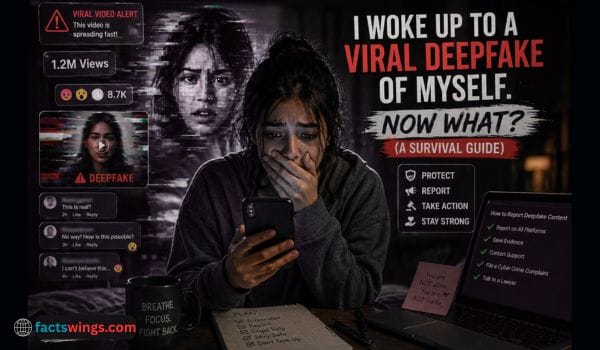
Picture: Deepfake Video Go On Viral
I. The Morning Everything Changed
It started like any normal day.
I woke up, reached for my phone, and saw notifications piling up. At first, I thought it was something good—maybe a post of mine was getting attention, or a message had gone viral for a positive reason.
But then I opened Twitter.
And I froze.
My name was trending.
That alone made my stomach drop.
Then I saw the video.
It was me—or at least it looked like me. My face. My expressions. Even my voice sounded disturbingly close.
But I had never recorded that video. I had never said those words. I had never been in that situation.
It was a deepfake.
And it was everywhere.
People were sharing it, reacting to it, judging it, laughing at it, believing it.
And I was just… staring at my screen, trying to understand how my life had split into “before this moment” and “after this moment.”
II. The First Reaction: Panic, Denial, Confusion
If you’re in this situation, your brain won’t work normally at first. Mine didn’t.
I went through stages in minutes:
- “This can’t be real.”
- “Maybe it’s edited?”
- “Why would someone do this to me?”
- “How do I stop this?”
- “Will anyone believe me?”
It’s a strange kind of violation because it’s not just privacy being invaded. It’s identity being rewritten.
You feel exposed in a way that’s hard to explain. Because the content isn’t just about you—it looks like you authored it.
That’s what makes deepfakes so dangerous.
They don’t just show a lie.
They make you look like the source of the lie.
III. The First Mistake I Made (Don’t Do This)
My first instinct was to respond emotionally.
I started replying to posts. I started arguing with strangers. I tried to convince people that it wasn’t real.
That was my mistake.
Because the internet doesn’t slow down for explanations.
Every reply, every denial, every emotional reaction just pushes the content further into visibility.
What I didn’t understand then—but I understand now—is this:
The more you engage emotionally in the early phase, the more you amplify the content.
I wasn’t fighting the problem. I was accidentally helping it spread.
IV. What I Should Have Done Immediately (And What You Should Do)
After the initial panic, I finally stopped reacting and started acting strategically.
Here’s what actually matters in the first 24–48 hours:
1. Do NOT engage publicly first
Don’t argue under posts. Don’t reply emotionally. Don’t try to “debunk” it everywhere.
You need control, not chaos.
2. Document everything
This part is critical.
I started taking screenshots of:
- The original post
- Reuploads
- Usernames
- URLs
- Timestamps
- Any platforms it appeared on
Because content gets deleted. Accounts get banned. But evidence is what you need for reporting.
3. Report it immediately on every platform
Most platforms now have policies for synthetic media or impersonation.
I reported it as:
- Impersonation
- Non-consensual synthetic media
- Defamation (in some cases)
It didn’t remove everything instantly—but it started the process.
4. Contact platform support (not just reporting tools)
This is something many people don’t do.
I sent direct reports to support channels explaining:
- It was a deepfake
- I am the victim
- It is non-consensual identity manipulation
Sometimes human review matters more than automated flags.
V. The Emotional Damage Nobody Talks About
People always talk about deepfakes as a “tech problem.”
It’s not.
It’s a psychological attack.
I stopped sleeping properly.
Every notification sound made my body tense.
I avoided opening social media.
I started wondering if people I know believed it.
Even when the video started getting taken down in some places, the feeling didn’t disappear.
Because once something like that exists online, you lose the feeling of control over your identity.
That’s the part nobody prepares you for.
VI. Talking to Friends and Family Was Harder Than Expected
One of the hardest moments was explaining it to people I know.
Because even though they trusted me, I could see the confusion in their eyes:
“If it looks so real… how can it be fake?”
That’s the cruel power of deepfakes.
Even truth feels negotiable.
But I had to be honest, calm, and consistent.
I didn’t over-explain. I just said:
“It’s fake. It’s AI-generated. I didn’t make it. I’m dealing with it legally and through platforms.”
And I repeated that without emotion every time.
Consistency mattered more than persuasion.
VII. Legal Steps I Took
After the initial chaos, I learned something important:
You can’t treat deepfakes like normal internet drama.
I contacted legal help.
Depending on your country, you may have options like:
- Defamation laws
- Cybercrime complaints
- Identity misuse laws
- Privacy violation claims
I won’t pretend it was fast or easy.
But starting the legal process created pressure that helped reduce spread over time.
Even the existence of legal action changes how platforms and people respond.
VIII. The Slow Down Phase
After a few days, something interesting happened.
The viral spike slowed.
Not because the internet suddenly became kind—but because attention moves fast.
New content replaced it.
But that doesn’t mean it disappeared. It just stopped being “trending.”
This is when most victims make another mistake:
They think it’s over.
It’s not.
Because deepfake content can resurface anytime.
So I kept monitoring.
I set alerts.
I checked periodically.
Not obsessively — but consistently.
IX. What Actually Helped Me Reclaim Control
If I had to summarize what genuinely helped, it’s this:
1. Taking control of narrative early
I posted a short, calm clarification once I had legal and platform steps in motion.
No emotion. No arguments. Just facts.
2. Reporting systematically, not emotionally
Every platform, one by one. Structured, consistent reporting.
3. Getting support (real support)
Talking to people I trust helped more than I expected.
Not for solutions — but for sanity.
4. Accepting that you can’t erase everything instantly
This was the hardest truth.
You can reduce visibility. You can remove links. But you can’t un-exist something from the internet completely.
That realization was painful — but freeing.
Because once I accepted that, I stopped chasing impossible control.
And started focusing on recovery.
X. If This Is Happening to You, Read This Carefully
You are not the first person this has happened to.
And unfortunately, you won’t be the last.
But here’s what I wish someone had told me on day one:
- You are not powerless, even if it feels like it
- The first 24 hours matter more than perfection
- Emotional reactions online make it worse, not better
- Documentation is your strongest weapon
- Platforms do respond, but not instantly
- The viral moment will fade, even if it feels endless right now
Most importantly:
A deepfake is a lie created about you — not a reflection of you.
People may see it.
Some may even believe it temporarily.
But identity is not defined by a fabricated clip.
XI. Final Thoughts: The Aftermath
It’s been some time since it happened to me.
Things are quieter now.
But I won’t pretend everything is “back to normal.”
Something changes in you after this kind of experience.
You become more aware of how fragile digital identity is.
You become more cautious online.
And you start understanding that in the age of AI, seeing is no longer believing.
But if there’s one thing I want to leave you with, it’s this:
You can survive it.
Not instantly. Not easily.
But step by step.
And slowly, you take your name back.
✅ Liked this article? Continue reading here: 👉 ডিপফেক (Deepfake) ভিডিও: বাস্তবতা ও সম্ভাব্য বিপদ